
Big Tech is spending $700 billion on AI infrastructure this year.[1] They're building the agents. But they're not building what makes those agents useful. That's our job.
I run a company that helps people get rid of stuff they don't need anymore. Furniture, appliances, the random pile in your garage you've been avoiding for three years. We figure out whether it should be sold, donated, recycled, or hauled away — and then we make it happen.
Last week, I started rebuilding our AI so that other AI agents can hire it.
Let me explain why that matters — especially if you're building something real.
The future isn't waiting for permission.
Neither are we.
What Actually Happened Last Week
On March 2nd, Santander and Mastercard completed Europe's first live payment executed entirely by an AI agent.[2] Not a demo. Not a pilot. A real transaction where an AI initiated and completed a payment on behalf of a human, in a regulated banking environment.
Nine days ago. We're still processing what that means.
Meta acquired Moltbook — a social network where only AI agents can post.[5] Sounds ridiculous until you realize what they actually bought: the people who figured out how to build agent identity infrastructure. A registry where agents are "verified and tethered to human owners."
That phrase — tethered to human owners — tells you everything. They're not buying a social network. They're building the identity layer for an economy where AI agents hire each other.
Here's What They're Building
It's basically the internet stack, rebuilt for machines:[6]
| Layer | Human Web | Agent Web |
|---|---|---|
| Identity | Passwords, OAuth | Agent Cards, registries |
| Communication | HTTP, REST APIs | MCP, A2A protocols |
| Discovery | Google, links | Agent marketplaces |
| Commerce | Credit cards, Stripe | x402, stablecoins |
OpenAI, Anthropic, Google, Microsoft, AWS, and Block are all co-governing these protocols through the Linux Foundation's Agentic AI Foundation (AAIF), launched December 2025.[4] Six competitors. One shared infrastructure.
That's the IETF moment for the agent economy. The protocols are converging whether anyone's ready or not.
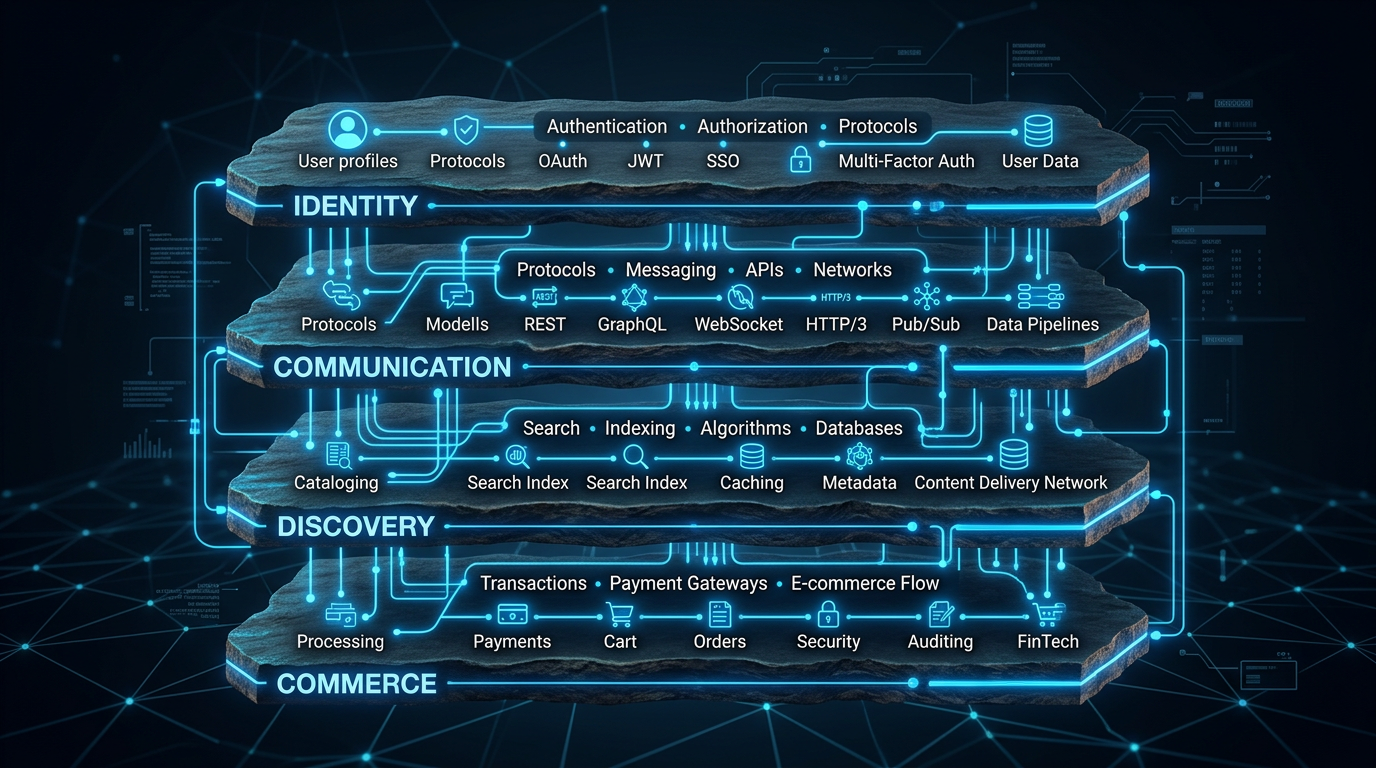
Four layers. Billions of dollars. Being built right now.
The Reality Check
Here's what the headlines won't tell you: x402 — the payment protocol that lets AI agents pay each other — processes about $28,000 in daily volume.[7] Not million. Thousand.
McKinsey projects $3-5 trillion in agent commerce by 2030. Current daily volume is $28K. That's a 100,000x gap between narrative and reality.
The early web had tiny numbers too. HTTP shipped before anyone understood XSS. JavaScript shipped before anyone had a security model. We're on the same trajectory — compressed into months instead of years.
40% of agentic AI projects will fail by 2027, according to Gartner.[8] That's not bearish — that's the same adoption curve every transformative technology follows. The 60% that survive will define the next decade.
Why This Matters If You Build Real Things
Here's the mental model that changed everything for me:
Within 2-3 years, everyone will have a personal AI agent. Apple Intelligence is already shipping. Google's building one. So is OpenAI. So is Meta. A recent survey shows 52% of consumers plan to use AI assistants for scheduling, and 41% for household tasks.[9] Saying "I don't have an AI agent" will be like saying "I don't have email" in 2010.
When someone tells their agent "get rid of my old couch," the agent has a problem. It can search the entire internet in milliseconds. It cannot conjure a pickup truck.
It Needs to Subcontract
Your service — whatever you're building — needs to be hireable by AI agents, not just findable by humans.
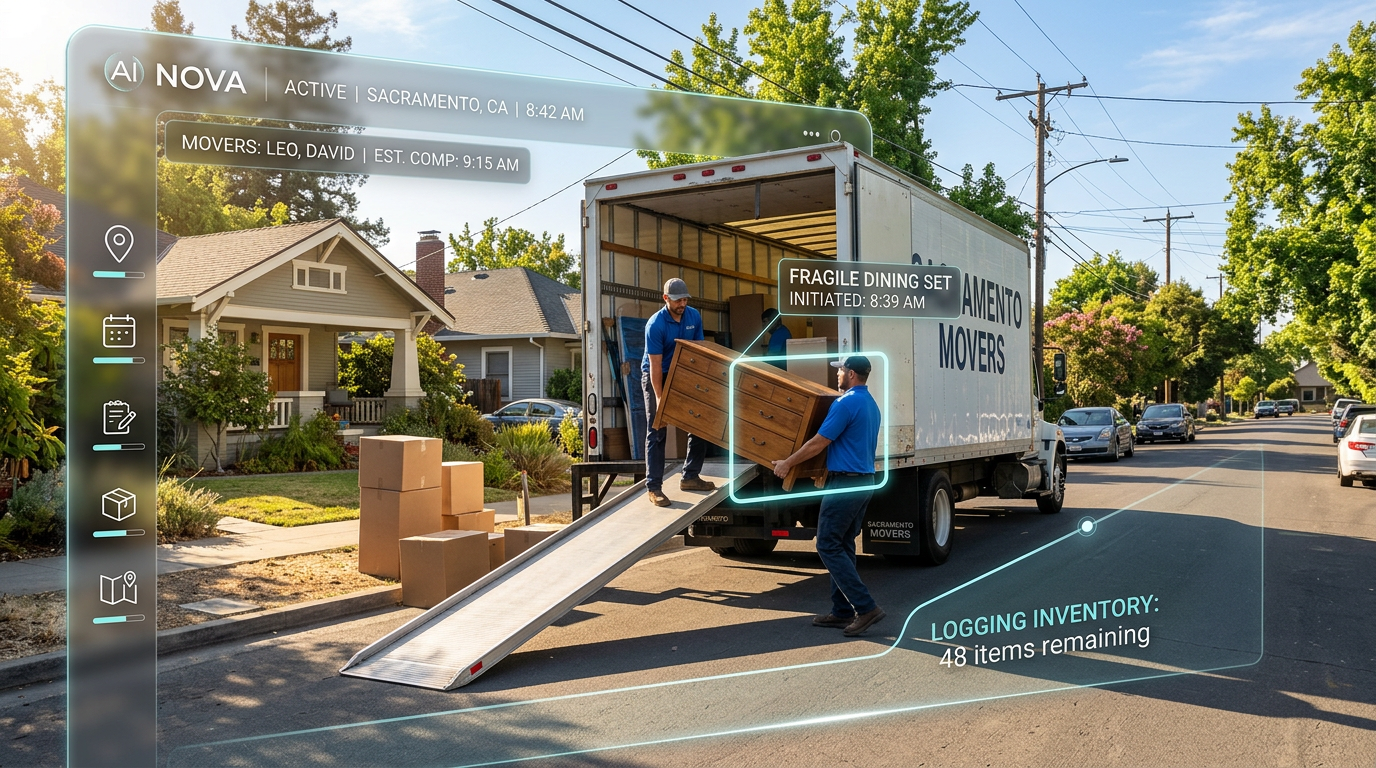
AI can think. Humans can execute. We're building the bridge.
What I'm Actually Building
Upcycle Hub helps people in Sacramento deal with stuff they don't want anymore. Our AI, Carl, knows whether something should be sold on Facebook Marketplace, donated to Habitat ReStore, taken to the electronics recycler, or hauled to the dump. Our provider, Parker, has the truck.
We turn other people's trash into resources. Furniture that would rot in a landfill goes to a family that needs it. Scrap metal gets recycled. Working appliances find new homes.
Last week, I started teaching Carl to be hired by other AI agents:
The human's agent picks an option. Carl schedules with Parker. Parker shows up. Bookshelf gets donated. The person's agent tells them: "Done. Donated to Habitat ReStore. Tax receipt attached. 85 lbs diverted from landfill."
The human never navigated a website. Never talked to a chatbot. Never sat on hold. They told their agent to handle it, and their agent hired my agent.
That's the agent economy.
The Risks (I'm Not Going to Pretend They Don't Exist)
- Security is broken right now 43% of early MCP servers have injection vulnerabilities, per 2025 security audits.[10] Moltbook had exposed databases and malware in its skills system.[11] We're building fast and security is behind. That's just the truth.
- Accountability disappears in agent chains When Agent A hires Agent B to access a database, who's responsible when something breaks? 23% of organizations are already running agentic AI in production with limited audit trails.[12]
- The identity fight will define the decade If Meta becomes the registry where all agents get verified, that's Facebook-level lock-in for an entirely new economy. The decentralized alternatives exist but they're early.
None of this is a reason to wait. All of it is a reason to build carefully.
Where This Goes
Mastercard is building "Know Your Agent" (KYA) — the same way KYC verified humans for traditional banking. Their Agent Pay program requires "trusted AI agents to be registered and verified."[13]
Google Chrome 146 shipped WebMCP in February 2026 — any website can now serve as a structured tool for AI agents.[14] Billions of pages just became agent-callable.
The consumer awareness moment already happened. ai.com ran a Super Bowl ad for personal AI agents on February 8th.[15] One month ago.
$700 billion in infrastructure spending this year. Nobody puts that kind of money into a trend that doesn't materialize.
The Question for Builders
You can wait until everyone has an AI agent and then scramble to be discoverable. Or you can plant your flag now, while the directories are empty and the early integrators are looking for services.
The agent economy won't be built by the AI companies. They're building the agents. The economy is built by everyone who makes those agents useful — the services they can hire, the physical world they can't touch alone.
Is your agent ready to be hired?
Sources
- [1] TechCrunch, "Hyperscalers planning nearly $700 billion on data center projects in 2026," February 2026. techcrunch.com
- [2] Mastercard Newsroom, "Santander and Mastercard complete Europe's first live end-to-end AI agent payment," March 2, 2026. mastercard.com/news
- [3] Solana News, "x402 has processed over 100 million payments since May 2025," February 2026. solana.com
- [4] Linux Foundation, "Agentic AI Foundation (AAIF) launched with six co-founders," December 2025. linuxfoundation.org
- [5] Axios, "Meta acquires Moltbook, hires founders to Meta Superintelligence Labs," March 2026. axios.com
- [6] IBM Research, "A2A protocol enables interoperability between AI agents from varied providers," 2025. research.ibm.com
- [7] CoinDesk, "Despite $7B ecosystem valuation, x402 processes ~$28K daily volume," March 2026. coindesk.com
- [8] Gartner, "40% of agentic AI projects will be cancelled by 2027," 2026. gartner.com
- [9] Index.dev Consumer Survey, "AI assistant usage intentions: scheduling 52%, household tasks 41%," February 2026. index.dev
- [10] Security audit findings cited in arXiv paper on MCP vulnerabilities, 2025. arxiv.org
- [11] InfoWorld, "Security researchers found malware distributed through Moltbook skills," February 2026. infoworld.com
- [12] Prof. Hung-Yi Chen research, "23% of organizations running agentic AI at scale in production," 2026.
- [13] Payments Dive, "Mastercard Agent Pay requires registered and verified AI agents," January 2026. paymentsdive.com
- [14] Prof. Hung-Yi Chen, "Google Chrome 146 Canary shipped WebMCP February 13, 2026."
- [15] DL News, "ai.com launched autonomous AI agent with Super Bowl commercial February 8, 2026." dlnews.com